


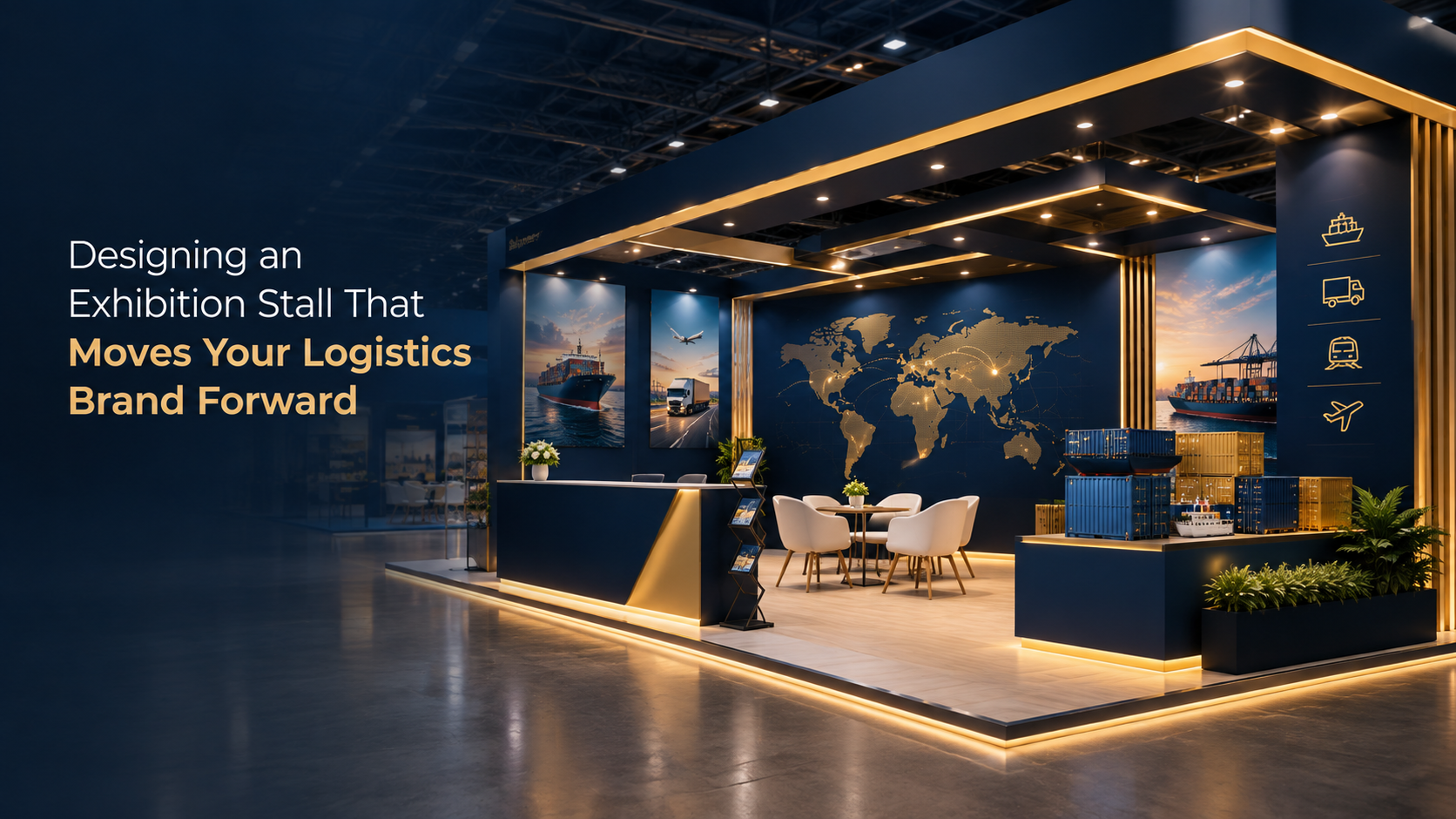
There are only a few seconds to convince visitors at your stall who you are, what you do, and why they should stop.
That can be a challenging prospect for a business in the logistics sector. You might have to convey freight services, freight/goods capability, trade routes, ports, markets, and industry expertise in a small space.
All that information becomes a clear visual experience on a successful logistics exhibition stand. It's all about getting noticed, explaining the business in a short way, and providing opportunities for meaningful conversations.
How to design a stall for an exhibition for a logistics company?
Begin by defining your goal for your exhibition, and then design your stall based on visitor flow, clear messaging of service, branding, relevant logistics visuals, meeting points, and lead capture.
Consider the visitor journey to be:
See → Understand → Engage → Enquire
All aspects of the stall should facilitate that journey.
1. Determine Your Exhibition Goal
Set goals for the stall before selecting colours, graphics, or furniture.
A logistics firm could come to an exhibition to:
- Create new leads.
- Meet existing clients
- Sponsor a new service or route
- Build brand awareness
- Meet agents and business partners
- Enter a new market
The entire exhibition stall design should be influenced by your goal.
For example, an open layout, a visible CTA, a reception point, and a QR code would be required for a lead generation stall. If there is a stall for meeting clients, more discussion space may be needed.
2. Design layouts to accommodate visitor circulation
The layout of an exhibition booth should be easy to get in and around.
First, think about how visitors would enter your stall from the aisle. You want your company name and main message to be prominent before they even get in the door.
A logistics stall should have separate sections for:
- Focusing on brand and key messaging.
- Service presentation
- Displays for routes and networks
- Digital screens
- Priority for reception and lead collection.
- Client meetings
- Storage
Do not block the entrance and refrain from obstructing access with furniture.
The journey of a visitor should not be forced but natural.
3. Simplify your logistics services' understanding
Logistics firms can provide a variety of services. It can cause confusion in the stall if you attempt to show them all the same.
Instead, bundle similar services together, and provide brief, descriptive explanations.
|
Logistics Focus |
Visual Approach |
|
Ocean Freight |
Engage in trade, ships, ports |
|
Freight Forwarding |
Transportation and network maps |
|
Warehousing |
Exhibits and storage graphics |
|
Customs |
Clearance and documentation illustrations |
|
Project Cargo |
Heavy lift and project imagery |
Visitors shouldn't have to read paragraphs of text to understand your core.
It's all about service – not explanation.
4. Make Your Logistics Network a Visual Story
Logistics companies possess one thing that is a big benefit to them: their network.
Routes, ports, destinations, vessels, cargo, and trade lanes can all be visual components of your stall.
You can showcase:
- Key ports and destinations
- Major trade lanes
- The exam has a regional or worldwide scope.
- Shipping routes
- New service connections
- Important markets
Don't always show all locations, but show the ones important to your exhibition audience.
A simple network map can get your message out a lot quicker than a long description about your company.
5. Create a clear visual hierarchy
The structure of your stall should be able to respond to these four questions:
Identify self, explain occupation, explain why it is important, and explain what to do next.
Use your:
- Logo and company name
- Core message
- Service categories
- Key differentiators
- Relevant visuals
- Please scan this QR code or contact CTA
- Provide adequate space around critical information.
- Don't overstuff all the walls with text, certifications, achievements, and service descriptions.
An effective stall design can be a big help in noticing important information.
6. Build a Business Story with Visuals to Explain
The logistics service is, in most parts, an invisible service. These, like freight forwarding, route planning, customs coordination, or cargo movement, are activities that cannot be seen by the visitor.
Your visuals must then help make those services more visual.
If your business is like one of these, you may consider:
- Ships and ports
- Containers and cargo
- Warehouses
- Trucks and transport
- Project cargo
- Route maps
- Shipment photographs
- Service icons
- Industry-specific graphics
Select images that support your exhibition purpose, not just beautiful stock photos.
7. Design the Stall for Business Conversations
Exhibitions do not just look good and appeal to the audience. They are moments to connect with clients, agents, partners, and prospective customers.
Provide a convenient gathering place while maintaining an adequate amount of space.
If you only need a table or two for a little quick discussion, it may be sufficient. For longer business meetings, if your group gets into this habit, then you might want to consider a more private discussion space.
Set up meeting rooms to be out of the way of the heaviest traffic, but still easy for your staff to access.
By designing a space to bring a visitor from a superficial introduction to a substantive business conversation, a well-planned space can facilitate the process.
8. Add Lead-Generation Elements
It's not just the impressive-looking stall that is important; it's how you can convert that interest into an enquiry.
Consider adding:
- A visible QR code
- Enquiry/CONTACT forms
- Digital brochure access
- Consultation booking
- Business card collection
- Clear service-specific CTAs
- Clearly point to the next step
For instance, if someone wants to know about ocean freight, they're not going to have to find out how to do so with your team.
When it comes to attracting visitors, it's not enough. The stall should also be set up to provide an opportunity to keep the dialogue going.
9. Use Digital Displays With a Purpose
A screen can introduce movement and information elements to a logistics stall, but it needs to be combined with the overall design of the stall.
Use them for:
- Service videos
- Shipping routes
- Project highlights
- Port or Vessel Information
- Company presentations
- Service locations
- Digital brochures
Limit the amount of text on the screen and make it readable. It may only be viewed by visitors for a few seconds as they pass by.
Technology should serve to enrich the visitor's experience, not be the focus.
10. Be Visible from the Aisle
It is important that visitors can recognise your company before they arrive at the stall.
Position the company name and logo at a prominent level. Utilize the upper levels and back walls, or other areas of interest, to provide a sense of openness throughout the exhibit hall.
Consider what you want visitors to observe as they pass you:
The name of the company or organization → Description of their products or services → Why they will need to stop
Your brand should also be consistent with your website, sales materials, and other sales communications. The stall should be a part of your company, not completely distinct.
Avoid these common mistakes for your Exhibition Stalls
All stalls look good when they are well designed, but when the basics are not followed, all they can do is lose their impact.
Avoid:
- Excessive text that visitors don't have the time to read
- Roughly estimated parking spaces that do not allow for easy access
- Low visibility of weak branding, which can only be identified from the aisle
- Too many images for the brain to keep track of
- Furniture that obstructs the movement of visitors
- Too much confusion around your messaging, so your services aren't understood
- No obvious call to action to guide people who want to get in touch
The ideal design is visible, informative, mobile, and business-oriented.
Frequently Asked Questions
1. What are the items to be included in a logistics stall at an exhibition?
The essential features of a logistics stall are clear branding, key services, appropriate logistics visuals, network/route information, a visitor-friendly layout, meeting space, and a simple contact form for the company.
2. What can be done to increase the number of visitors to a logistics stall?
Visitors may be attracted by good visibility, short, clear messages, appropriate imagery, an open layout and a clear reason to stop. The most important part of your message should be in view from the exhibition aisle.
3. What can I do to get logistics leads from an exhibition stall?
Ensure clear service-specific CTAs, QR codes, enquiry forms, consultation areas and/or staff to engage visitors. The design should facilitate the next steps for any visitor who is interested.
Make your logistics exhibition stall a success with Vink Designs!
Just like your logistics services, your exhibition stall should be clear, organized and have a purpose.
Vink Designs creates and implements exhibition stands for logistics and other B2B brands, keeping branding, layout, movement of visitors, service presentation, and realisation in mind.
Whether it's the initial concept or the final completed stall, it's all about making it a place that's representative of your brand and conducive to real business talk.
Looking for the perfect booth design for your next logistics trade show? Get in touch with Vink Designs.
Our trusted IT practices are designed to enhance operational efficiency, ensure data integrity, and provide peace of mind through proactive security and strategic planning. From implementing reliable backup solutions to safeguarding your network against emerging threats, we help businesses.