

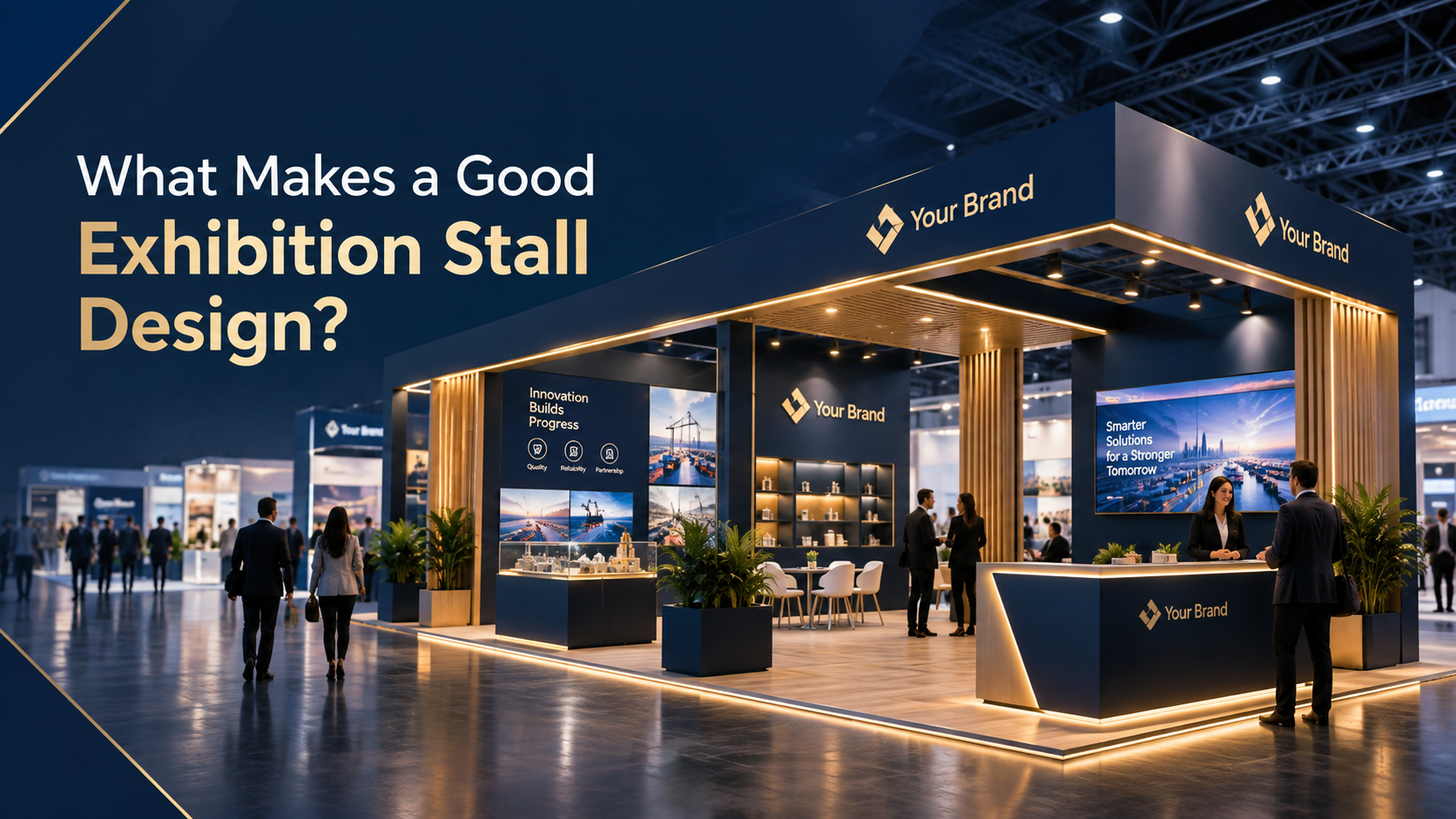
A great exhibition stall catches the attention of passersby, communicates your business in a matter of seconds, gently leads passersby to the spot and provides a forum for discussion.
While at an exhibition, visitors make rapid decisions concerning which of the stalls to explore and which to leave. Your exhibition stall design should convey your brand, services, and value before someone has even had a chance to engage in a sales conversation.
For logistics companies, this can be more challenging. Logistics is a service, a network, a move, and a coordination, while a physical product is not. You should transform these complicated thoughts into something that is easily comprehensible to anyone who views the stall.
Then what constitutes a good exhibition stall design?
It should appeal, educate, direct, interest, and persuade.
The 5 Things a Good Exhibition Stall Should Do
A well-designed exhibition stall should:
- Attract — Make a statement from the show aisle.
- Explain — Make business & services easy to understand.
- Guide — Assist visitors to flow through space in a natural way.
- Engage — Foster relaxed dialogue.
- Convert — Provide a next step for interested visitors.
Each design decision should work towards achieving one or more of these goals.
1. Use a simple, clear, and practical layout
The ideal exhibition stall setup is one that's constructed in such a way that it will benefit both the visitor and the attendant(s).
People visiting should not be restricted by being pushed or shoved around to access the displays or speak with staff. Meanwhile, your team should have a room to work, meet prospects, store materials, and handle enquiries.
Stall size will determine the amount needed:
- Brand and messaging areas
- Service displays
- Details of products or solutions.
- Registration desk or information desk
- Meeting space
- Storage
Assign an objective to each area. Do not put large furniture or displays in the way of the entrance or add unnecessary bottlenecks to the entrance.
2. Launch Your Campaign Online
Before visitors enter the stall, it should be easy to recognize.
Display your logo, company name, and key message from various locations throughout the exhibition area. The same colours, fonts, graphics and imagery should also be consistent throughout your overall identity.
Visual elements that may be pertinent to a logistics company may encompass:
- Containers and cargo
- Ships and ports
- Trade routes
- Warehouses
- Transportation
- Industry-specific imagery
The objective is NOT to saturate all surfaces with the brand. It is to make a distinct visual imprint that is easily recognizable.
3. Communicate a Message that Visitors can understand
While a visually impressive stall is necessary, it also needs to answer one simple question:
What is your company's business?
The essence of your message needs to be succinct enough that it can be easily grasped as you are walking down the street. Don't use too much detail in the service description or technical terms.
A logistics firm could feature:
- Freight forwarding
- Ocean freight
- Vessel operations
- Customs services
- Warehousing
- Project or special cargo
- Key trade routes
A good hierarchy of messages is:
Headline → Services → Proof → Action
The headline conveys the action. Services reveal what you're available to do. Proof provides visitors with a reason to trust you. The action lets them know what to do next.
4. Designed for natural visitor flow
The objective of good booth design is to make it feel easy.
Consider what your visitors will see when they approach your stall, where they will naturally go, and what they will see first.
To ensure high-traffic areas remain open and to place important information in easy-to-read areas. Meeting areas should be easily accessible to the main visitor path.
In larger stalls, various sections can be used for a variety of purposes:
|
Area |
Purpose |
|
Display |
Share services and solutions |
|
Reception |
Establish a welcoming and qualifying environment for visitors |
|
Meeting |
Hold business discussions |
|
Storage |
Store materials in an orderly way and out of sight |
The layout should invite visitors to explore the site while not imposing any specific or predetermined path on them.
5. Present the concept of logistics using visuals
Not everything in logistics is easily identifiable, so it can be hard to explain logistics.
Freight coordination, planning, handling, and customs are all things that a visitor cannot see. Your stall can help these services be more readily understood through a visual story.
You can demonstrate, for instance:
Cargo - Route - Port - Handling - Destination
Use:
- Network maps
- Trade lanes
- Port photography
- Vessel imagery
- Cargo photographs
- Simple process diagrams
- Service-specific icons
Avoid using all destinations or services. Emphasize information that is most salient to your exhibition audience.
6. How to blend information with visual space
One of the common errors that many people make is attempting to place everything on the stall.
Overloaded text causes readers to cease reading the webpage. Having too little information can cause them not to know what you have to offer.
Keep headlines brief, and supporting text and imagery brief and to the point. Leave sufficient space around your most important messages.
For example:
Instead of:
Delivering full end-to-end logistics solutions in multiple markets…”
Use:
Connecting the world by sea, air, and land.
The shorter message can be more easily (and more often) noticed, understood, and remembered.
7. Avoid Overloading the Stall
In B2B logistics, where trust and reliability are paramount, one question visitors may have is why they should place their trust in your company.
Apply some of the following points as examples of evidence:
- Relevant certifications
- Key markets served
- Years of experience
- Significant projects or points of interest during the shipment
- Industry memberships
- The use of suitable client or partner references
It is not necessary to show each achievement. Select evidence to support the point you wish to leave visitors with.
8. Bring about a space where real business dialogue takes place
An exhibition stall should offer more than a few short words of introduction.
A meeting room that is comfortable allows your team to discuss services, gain an understanding of your requirements, and develop relationships with prospects, clients, and business partners.
Depending on the available space, this could be:
- Small table and chairs to use for short conversations
- A meeting area that has been set aside for the purpose.
- A semi-private space for extended discussions
Ensure meeting areas are available but do not take up all the stall space.
9. Make the Next Step Easy
It's simply the start of the process when you attract a visitor. The stall should facilitate a continuation of the conversation if someone is interested in your services.
Consider including:
- QR codes
- Enquiry forms
- Digital brochures
- Consultation booking
- Contact information
- Service-specific CTAs
If the visitor has an interest in project cargo, for instance, he or she should be able to locate a quick method to communicate with the appropriate team.
A simple journey is:
Attention, Interest, Conversation, Lead
10. Use Lighting and Practical Details strategically
Lighting can have an impact on visitors seeing your branding, graphics, displays and meeting spaces.
Don't just light up the whole stall; use it to accentuate key features.
- Take some practical considerations into account, such as:
- Space for brochures and personal items
- Accessible power points
- Screen placement
- Cable management
- Comfortable seating
- Easy-to-clean surfaces
- Graphics are clearly visible.
All these aspects are important and can make a huge difference between a design concept looking good on paper and it being a great success on the ground at an exhibition.
Common Exhibition Stall Design Mistakes
A good design for an exhibition booth can fall short if attention is not paid to the fundamentals.
Avoid:
- Excessive text not read by visitors
- Not visible from the aisle – weak branding
- Bustling scenes with limited space for circulation.
- Excessive visuals for attention
- The furniture arrangement creates an obstruction of visitor traffic.
- There is no designated area where meaningful conversations can take place.
- Clutter that is visible due to poor storage solutions
- Making only show designs, not function designs.
Stall design should be a compromise between looks, communication, movement, and business.
Exhibition Stands Checklist
Your final design will be ready when you ask yourself the following:
- Is it possible to tell from the aisle which company they are?
- Are they able to grasp the company's business in a matter of seconds?
- Can the main message be easily understood?
- Is there easy access for people to get around?
- Are the most important services readily available?
- Are the visuals on-brand and on-message?
- Do you have room for business discussions?
- Do you have a clear method of capturing enquiries?
- Is there visible clutter when it comes to storage?
- Does the stall work as well in practice as it looks in the design?
If the answer is yes, the stall is more than just pretty; it's working as a business space.
Get Your Exhibition Stall to Work for Your Business
An exhibition stall is not just a space that's been decorated. It should be a visible extension of your brand; it should capture interest, convey your offer, support your team, and be a way to initiate business conversations.
Exhibit design, branding, fabrication, and execution are combined at Vink Designs to create an exhibit space around your branding and business objectives.
Need to plan your upcoming show? Allow Vink Designs to transform your space into an experience that benefits your business.
Our trusted IT practices are designed to enhance operational efficiency, ensure data integrity, and provide peace of mind through proactive security and strategic planning. From implementing reliable backup solutions to safeguarding your network against emerging threats, we help businesses.